
BLOG
Why Construction Innovation Starts With Incentives, Not Technology
A robot hired by a facade subcontractor caught a $1 million mistake on a New York high-rise. The general contractor’s response was to commission a third-party survey to prove the robot wrong.
It wasn’t wrong, and the general contractor had to pay for the fix. If the error had gone undetected until the facade subcontractor stepped onto the site and implicitly accepted the working conditions, the subcontractor would have been responsible for the $1 million in rework costs.
That exchange captures something fundamental about why construction is failing to realize the productivity gains seen in other heavy industries like mining and manufacturing. Manufacturing has seen roughly 90% productivity growth since 2000, while construction has managed around 10%. The gap isn’t a technology problem. It’s an incentive problem.
That was the argument that emerged from MistyWest and intent’s HardTech Forum on The Internet of Building Things during NY Tech Week, where Dan Millar, VP of Growth at MistyWest, posed the question directly: if better tools exist, why does this industry move so slowly?

L to R: Dan Millar, Ben Williams, Niran Shrestha, Conley Oster and Stuart Robinson
MistyWest works with Seed to Series B startups and Fortune 1000 Innovation teams that are building novel products and need expertise and execution. Have a hard problem that needs solving? Tell us about it.
Every project is a prototype. So is every incentive structure.
In manufacturing, a process will be iterated, honed and replicated thousands (or millions) of times—a utopian scenario for scaling innovation.
Stuart Robinson, Operations Director at Mace Consult, has spent over 30 years in construction, where replication and iteration are not the case. “I’ve never built the same thing twice,” he said. That’s not just an observation. It’s the structural reality that makes scaling innovation so difficult. In construction, every project is a prototype of which variables multiply: site conditions, local labor markets, supply chains, regulatory environments. There’s no factory floor to optimize.
Add to that a fragmented ecosystem of owners, general contractors, subcontractors, insurers, and lenders, all under different contracts, with different risk profiles and different definitions of a good outcome, and even the most innovative technology will still struggle to find a buyer. As Raise Robotics co-founder Conley Oster put it: “You don’t really have time to try things that don’t work.” Job sites run on thin margins and tight schedules. There’s no budget for experimentation.
Niran Shrestha, CEO of workforce management platform Kwant AI, pushed back on the doom narrative. “The tech adoption is getting really good,” he said, pointing to the data-center construction boom as a forcing function accelerating digital deployment across major projects. Kwant currently has more than 350,000 connected devices on job sites globally—tracking workers, equipment, and activity in real time across construction and industrial environments. That level of visibility would have been unimaginable a decade ago.
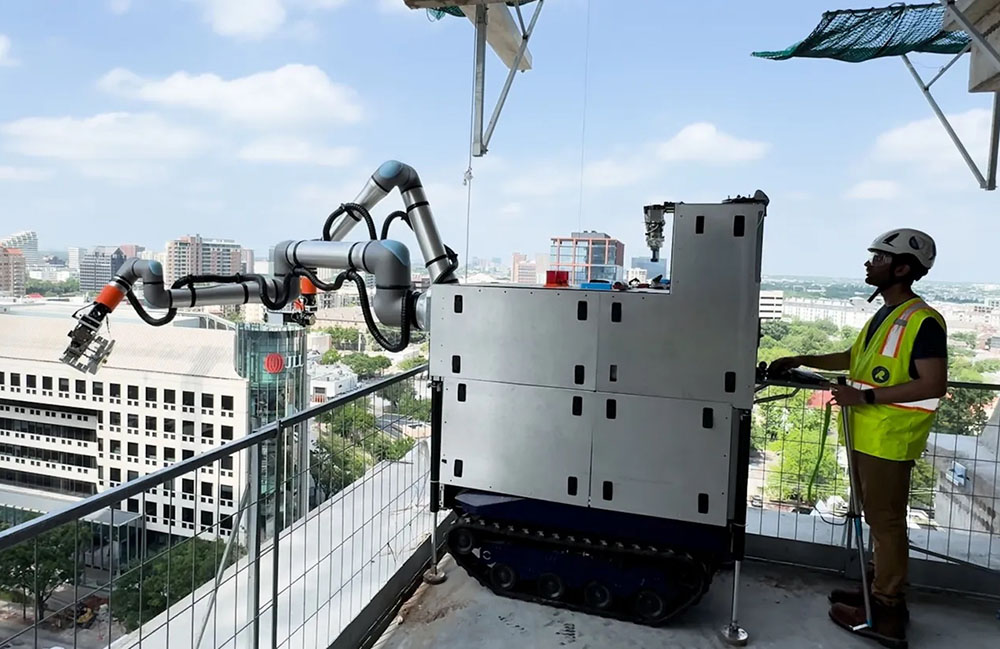
Raise Robotics on the job site. Image source: The Robot Report
Rapid data capture helps everyone get paid faster.
Everyone wants better information. Nobody wants to be the one paying for it.
According to Ben Williams, COO of Exyn Technologies, conversations often go something like “That sounds great. Someone should definitely buy that. I won’t—but someone definitely should.”
Construction is a large, complicated ecosystem where information doesn’t always flow cleanly between all parties, and payment cycles may take up to four months. Work gets done, and then it has to be verified, approved, documented, and signed off by multiple parties before anyone sees money.
Exyn’s autonomous mapping drones create accurate digital models of GPS-denied environments, from underground mines to active construction sites. By creating a trusted, third-party record of what’s actually happening in the field, that information becomes valuable far beyond the person operating the scanner.
“The challenge isn’t just collecting better data,” Williams said. “It’s delivering the right information to the right people at the right time, even if they’re not the ones buying the system.”
That last clause is the crux. Owners, insurers, and lenders increasingly want verifiable, third-party records of project progress. Figuring out who pays for it, and why, is the harder problem.

MistyWest’s VP of Growth Dan Millar with Ben Williams, COO of Exyn Technologies
Good news travels upstream, and not everyone wants it there.
We circle back to that New York high-rise. While performing routine layout work, a Raise Robotics system detected slab deviations large enough to prevent the building’s facade system from fitting as designed. Normally, this would have been discovered when the facade subcontractor arrived on site. At which point, by stepping onto the job site, they would have implicitly accepted responsibility for the existing conditions.
“By catching it early, we ultimately saved the subcontractor more than $1 million in rework costs,” said Oster.
But since Raise flagged the issue before the panels were installed, it became the general contractor’s responsibility to fix—and they weren’t exactly thrilled about this. “That’s where the misaligned incentives really show up,” continued Oster. They commissioned a third-party survey, not to get better information, but to make the existing information go away. The survey confirmed the robot’s findings.
Shrestha put it plainly: “In this industry, somebody’s fault is somebody else’s benefit. If something gets delayed and requires a change order, someone else is making money from that.”
Better information doesn’t just improve project outcomes: it reshuffles accountability. And for the party moving from the benefiting side to the responsible side, that can be a threat.

Niran Shrestha, CEO of workforce management platform Kwant AI
Robots won’t replace the foreman, but they will redraw the org chart.
One of the most interesting debates of the evening wasn’t whether construction would become more automated, but where the line between humans and robots will ultimately be drawn.
Shrestha argued that automation would first absorb repetitive, dangerous, and supervisory work, and as that happens, value would concentrate at the extremes: in the data platforms that manage it all, and in the skilled tradespeople who handle what machines can’t. “People who can build a unique house and paint a unique building are going to be the workers making the most money in the future,” he said.
Oster agreed that edge cases will always need human judgment. but challenged the assumption that specialized trades are safe from disruption. “I think you can knock 90% of it out using robots already,” he argued, if the industry is willing to redesign methods and workflows rather than asking robots to perfectly replicate what humans do today.
Both agreed on the near term: the first wave isn’t about wholesale replacement. It’s about the dangerous, repetitive, physically demanding work that slows projects and hurts workers. The bigger question is how long the remaining human bottlenecks will hold.

Our panelists pose for a post-discussion group photo.
The technology is ready. The deal structure isn’t.
The evening’s discussion hammered home that when the incentives aren’t aligned, it doesn’t matter if robots are catching million-dollar mistakes, or wearables are dramatically improving on-site safety.
Technology only creates value when the right people have a reason to use it. When catching a problem early means paying to fix it, some parties will choose not to catch it.
Construction’s productivity spike won’t come when the next robot ships. It’ll come when owners, contractors, subcontractors, insurers, and lenders all benefit from finding problems early; when better information creates shared winners instead of new losers.
The data already exists. The contracts just need to catch up.
Want to be in the room for the next HardTech Forum? Sign up for the MistyWest Community newsletter to be first to hear about upcoming events.